

The Importance of Galvanized Steel in Solar Power Plant Construction
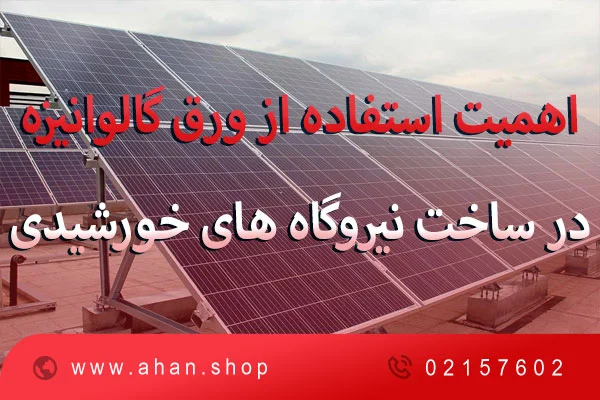
As solar energy projects continue to expand in Iran and worldwide, selecting suitable materials for photovoltaic (PV) mounting structures has become increasingly important. The posts, support frames, and mounting rails that hold solar panels in place are continuously exposed to environmental conditions, including moisture, rainfall, dust, solar radiation, and significant temperature fluctuations.
Under these conditions, materials must offer both adequate structural strength and long-term corrosion resistance. Galvanized steel is widely used in solar PV mounting systems because it combines the mechanical properties of steel with the corrosion protection provided by a zinc coating.
Galvanized Coatings: Long-Term Corrosion Protection for Solar Structures
Galvanized steel is produced through hot-dip galvanizing, a process in which steel is immersed in molten zinc to form a protective coating on its surface. For steel sheets and coils, this is typically carried out on a continuous galvanizing line, while finished structural components may be galvanized after fabrication. The resulting zinc coating provides both a physical barrier against environmental exposure and sacrificial protection for the underlying steel.
Unlike ordinary paint coatings, which primarily provide a barrier against environmental exposure, hot-dip galvanized coatings are metallurgically bonded to the steel substrate. This strong adhesion helps the coating withstand handling, forming, and service conditions. The zinc layer also provides sacrificial corrosion protection at minor scratches and exposed areas, contributing to the long-term durability of steel components in outdoor environments.
Why Is Galvanized Steel Widely Used in Solar PV Mounting Structures?
When designing and installing solar PV mounting structures, three key considerations are corrosion resistance, long-term structural durability, and life-cycle cost. Galvanized steel offers several advantages that make it a practical material choice for these applications.
1. Corrosion Resistance in Demanding Environments
Solar power plants are often installed in desert, arid, humid, or coastal regions, where structural components may be exposed to moisture, airborne salts, dust, and other corrosive elements. Under such conditions, unprotected carbon steel can deteriorate over time. Galvanized steel with coating designations such as Z275 or Z350 can provide effective corrosion protection when the coating specification is appropriate for the site conditions. However, the expected service life depends on environmental corrosivity, coating thickness, and maintenance requirements. Coating designations alone do not guarantee a specific service life.
2. Reduced Maintenance Costs
Conventional painted steel structures may require periodic surface preparation and repainting to maintain corrosion protection. For large-scale solar power plants with hundreds or thousands of support posts and mounting components, these maintenance activities can be costly and time-consuming. In comparison, properly specified galvanized steel structures generally require less frequent coating maintenance, helping reduce operating costs over the project life cycle.
3. Surface Reflectivity and Thermal Considerations
The metallic surface of newly galvanized steel can reflect a portion of incoming solar radiation, although its reflectivity varies with surface finish and weathering. While this characteristic may influence surface temperature, the thermal performance and dimensional stability of solar mounting structures depend primarily on structural design, material properties, thermal expansion, and installation conditions. Appropriate engineering design is therefore essential to accommodate temperature variations in hot climates.
4. Structural Performance Under Wind and Snow Loads
Galvanized steel sheets with thicknesses ranging from 2 to 4 mm can be formed into structural profiles for certain solar mounting applications, depending on the steel grade and component design. These profiles can provide the required strength and stiffness when properly engineered. However, their ability to withstand wind pressure, snow loads, and dynamic forces depends on factors such as section geometry, member spacing, connections, and bracing. Steel thickness and coating specifications must therefore be selected according to the structural design requirements of each project.
Galvanized Steel vs. Other Materials Used in Solar PV Mounting Structures
| Material | Advantages | Limitations |
|---|---|---|
| Galvanized Steel | Good corrosion resistance, cost-effective, long service life when properly specified | Relatively high weight compared with aluminum |
| Stainless Steel | Excellent corrosion resistance with appropriate grade selection, attractive surface finish | Generally higher material costs |
| Aluminum | Lightweight, good corrosion resistance, easy to fabricate | Strength and stiffness depend on alloy and section design; material costs may be higher |
| Painted Carbon Steel | Potentially lower initial cost, flexible coating options | May require periodic inspection, maintenance, and recoating depending on the coating system and exposure conditions |
Recommended Technical Specifications for Solar PV Mounting Structures
The appropriate steel grade, sheet thickness, and corrosion protection system should be determined according to the structural design, environmental conditions, and required service life of each solar power project. The following considerations can help guide material selection:
- Zinc Coating: For continuously galvanized steel sheet, coating designations such as Z275 (275 g/m²) may be considered, depending on environmental exposure. Higher coating masses or alternative protective systems may be required for more corrosive environments.
- Steel Thickness:
- Support posts: 2 to 4 mm may be suitable for certain cold-formed profiles, subject to structural calculations.
- Mounting rails: 1 to 2 mm may be suitable for certain designs, depending on the steel grade, profile geometry, span, and applied loads.
- Material Standards: EN 10346 or ASTM A653/A653M for continuously hot-dip galvanized steel sheet. Fabricated steel components galvanized after manufacturing are typically specified according to EN ISO 1461 or ASTM A123/A123M, as applicable.
- Coating Process: Hot-dip galvanizing is widely used for outdoor structural applications. Electrogalvanized coatings generally provide thinner corrosion protection and should not be selected for demanding outdoor environments without appropriate engineering assessment.
For certain applications, 55% aluminum-zinc alloy-coated steel, commonly known as Galvalume, may also be considered as an alternative corrosion-resistant material. This coating system is covered by ASTM A792/A792M and offers different corrosion performance characteristics from conventional zinc coatings. Its suitability and expected service life must be evaluated according to the specific application, coating specification, and environmental conditions.
Important Installation Practices for Improving Structural Durability
- Protection of Cut Edges and Drilled Holes: Inspect cut edges, drilled holes, welds, and other areas where the protective coating may have been damaged. Where repair is required, use an appropriate zinc-rich coating or another approved repair method in accordance with the applicable specifications.
- Corrosion-Resistant Fasteners: Use appropriately specified fasteners, including hot-dip galvanized bolts and nuts where suitable, and ensure material compatibility to minimize galvanic corrosion.
- Proper Drainage: Design structural components and connections to prevent water accumulation and prolonged moisture exposure.
- Protection at Ground and Concrete Interfaces: Assess corrosion risks where steel components are embedded in soil, installed near ground level, or in contact with concrete. Select suitable protective measures based on soil conditions, moisture exposure, and the foundation design.
Economic Analysis: Why Galvanized Steel Can Be Cost-Effective in the Long Term
Although galvanized steel structures may have a higher initial cost than uncoated or certain painted carbon steel alternatives, they can offer significant long-term economic advantages. Over a typical solar power project life cycle of 20 to 30 years, properly specified galvanized coatings can reduce the frequency of corrosion-related maintenance and the need for recoating.
The total cost of ownership (TCO) should account for initial material and installation costs, inspection, maintenance, repairs, and potential component replacement. By reducing these requirements, galvanized steel can provide a lower life-cycle cost than some conventional painted steel systems. However, actual savings depend on environmental exposure, coating specifications, maintenance strategies, and project conditions.
Conclusion: Durable Steel Infrastructure for Solar Energy Projects
Solar power plants represent long-term investments, making the durability of their supporting structures an essential consideration. Mounting systems must maintain their structural integrity and corrosion protection throughout the intended operating life of the installation.
With an appropriate zinc coating specification, suitable steel grade, and proper installation practices, galvanized steel offers a reliable and cost-effective solution for solar PV mounting structures. Its combination of structural performance, corrosion resistance, and relatively low maintenance requirements makes it a practical choice for solar energy projects across different climatic regions of Iran.
Galvanized Steel Sourcing for Solar Power Projects from Ahan Shop
Ahan Shop, operated by Tehran Galvanizeh Borna, provides sourcing and supply services for galvanized steel coils and sheets used in industrial and construction applications, including solar PV mounting structures. We work with Iranian and international steel producers to help customers source products according to their technical and project requirements.
Our steel supply services include:
- Competitive Quotations: Pricing based on product specifications, order quantities, and market conditions.
- Flexible Order Quantities: Supply options for both small orders and bulk requirements.
- Technical Documentation: Product specifications and relevant mill certificates, where available.
- Delivery Coordination: Supply and delivery arrangements based on order requirements and destination.
For assistance with galvanized steel sourcing for solar power projects or to request a quotation, contact the expert team at Tehran Galvanizeh Borna on +98 21 57602.
How would you rate this article?
Help us provide better content by registering your rating.
Related Articles
-
What Is Galvanizing? Methods and Applications
Learn how galvanizing protects steel, compare hot-dip and cold galvanizing methods, and explore their applications and key coating quality criteria.
60 minutes of study time -
Shipping Container Steel: Types, Thicknesses and Selection Guide
Which steel is best for shipping containers? Compare Corten, galvanized, and prepainted steel, with a thickness guide for container walls and roofs.
40 minutes of study time -
Steel Sheets and Plates for Industrial Sheds
Compare hot-rolled, galvanized and prepainted steel for industrial sheds. Explore sheet thicknesses, roofing and cladding applications, and selection guidelines.
40 minutes of study time
Add a comment
The Importance of Galvanized Steel in Solar Power Plant Construction