


What Is Galvanizing? Methods and Applications
Galvanized steel is steel coated with zinc (Zn) to protect the underlying metal against corrosion. The process of applying the coating is known as galvanizing (also called galvanization). Galvanized steel is not a separate metal or alloy; it is steel protected by a zinc coating.
Uncoated steel is susceptible to corrosion when exposed to moisture and oxygen. The zinc coating provides a physical barrier against the environment and offers sacrificial corrosion protection through an electrochemical mechanism. This combination of protective properties is a key reason for the widespread use of galvanized steel in industrial and construction applications.
For buyers, understanding this distinction is an important starting point. Two galvanized steel sheets with similar appearances may differ significantly in zinc coating mass, steel grade, and formability. Product selection therefore requires more than an assessment of surface appearance and nominal thickness.
The History of Iron and Steel: From Early Tools to Industrial Production
The use of iron dates back thousands of years. Before iron extraction from ore became widespread, some ancient civilizations used meteoritic iron to produce small objects and tools. A major technological breakthrough occurred when early metalworkers developed methods of extracting iron from ore using heat and carbon-based reducing agents. The spread of ironworking techniques across the ancient Middle East and other regions contributed to the emergence of the Iron Age. For further information, see our article on the History of Iron.
Steelmaking also has a history extending far beyond the Industrial Revolution. Over time, metalworkers discovered that heating conditions, carbon content, and forging techniques could influence the hardness and mechanical properties of iron. Ancient civilizations, particularly in India and China, developed various methods of producing steel. For centuries, however, steelmaking remained labor-intensive and heavily dependent on the expertise of skilled metalworkers.
A major turning point came in the nineteenth century with the development of industrial-scale steel production. The introduction of the Bessemer process in 1856, followed by advances in other steelmaking technologies, made it possible to produce large quantities of steel at significantly lower costs. This transformation supported the expansion of railway networks, bridges, industrial machinery, and steel-framed structures. The Bessemer process should therefore be recognized as a milestone in the industrialization of steel production rather than the origin of steelmaking itself.
Galvanizing Explained
Galvanizing is the process of applying a protective layer of zinc (Zn) to the surface of iron or steel to reduce corrosion. Depending on the galvanizing method, the coating may be deposited onto the surface or form a metallurgical bond with the underlying metal. The resulting product is known as galvanized iron or galvanized steel, depending on the base material.
Galvanized steel is therefore not a distinct metal. In galvanized steel sheets, for example, steel forms the base material, while the zinc coating provides corrosion protection. Zinc coatings can also protect other steel products, including pipes, wire, wire mesh, fasteners, and fabricated components. However, the appropriate galvanizing process and applicable standards vary according to the product type.
The steel substrate and the zinc coating perform different functions. Mechanical properties such as strength, ductility, and formability depend primarily on the steel grade and its processing condition, while the zinc coating improves the material's resistance to corrosion. Consequently, the presence of a galvanized coating alone does not determine a product's load-bearing capacity or suitability for structural applications.
History of Galvanizing
The use of zinc to protect iron has a history spanning several centuries. In 1742, French chemist Paul Jacques Malouin presented research describing how iron could be coated by immersion in molten zinc. In the 1830s, French inventor Stanislas Sorel developed and patented an early practical galvanizing process, helping establish the commercial production of zinc-coated iron.
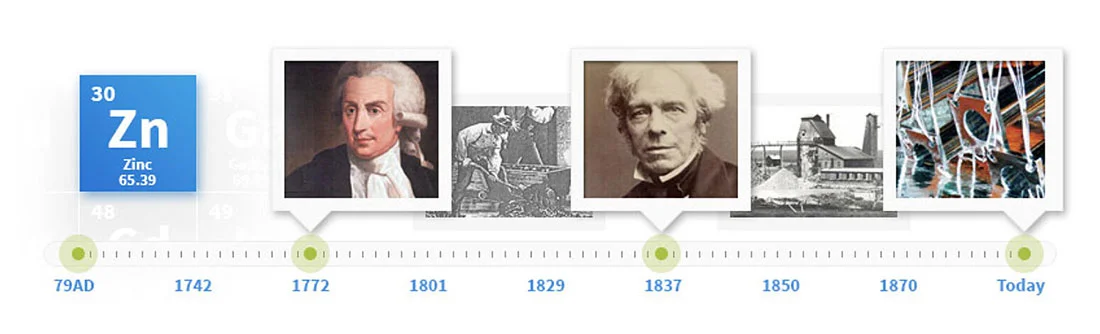
Early Uses of Zinc
Zinc and zinc-containing alloys were used long before the development of modern galvanizing. However, these early applications should not be confused with the hot-dip zinc coating of iron and steel, which emerged much later.
1742
French chemist Paul Jacques Malouin presented his findings to the French Royal Academy of Sciences, describing a method of coating iron by immersing it in molten zinc. His work is widely recognized as an important early milestone in the development of hot-dip galvanizing.
1780s
Italian physician and scientist Luigi Galvani, whose name later became associated with galvanizing, carried out experiments on the electrical stimulation of frog muscles. His research helped advance the early understanding of electrical phenomena and contributed to the development of electrochemistry.
1800
Alessandro Volta developed the voltaic pile, an early electric battery that demonstrated how a continuous electric current could be generated through the interaction of dissimilar metals and an electrolyte. This achievement marked an important step in the development of electrochemical science.
1829
Michael Faraday investigated the sacrificial protective action of zinc through experiments involving zinc, iron nails, and salt water. These observations contributed to the understanding of the electrochemical principles underlying corrosion protection.
1836–1837
French inventor Stanislas Tranquille Modeste Sorel developed and patented methods for protecting iron with zinc during this period. Accounts of the earliest patent activity cite 1836 or 1837, depending on the filing and jurisdiction. His work helped establish hot-dip galvanizing as an industrial process.
1850
By 1850, the British galvanizing industry was consuming approximately 10,000 metric tons of zinc annually to protect iron products against corrosion, reflecting the growing industrial adoption of galvanizing technology.
1870
The first galvanizing plant in the United States began operating in 1870. At that time, iron and steel products were typically manually immersed in molten zinc baths, before the development of the more automated galvanizing processes used today.
2000
By the beginning of the twenty-first century, advances in metallurgy, furnace technology, process control, and environmental management had improved process efficiency, coating consistency, and environmental performance. Continued technological development has supported the production of galvanized steel for increasingly demanding industrial applications.
How Does a Galvanized Coating Protect Steel?
The protective role of zinc (Zn) extends beyond covering the steel surface. Zinc helps protect steel against corrosion through three main mechanisms.
1. Barrier Protection
The zinc coating acts as a physical barrier, limiting direct contact between the underlying steel and environmental factors such as moisture, oxygen, and corrosive substances. Coating continuity, proper adhesion, and resistance to mechanical damage are important for maintaining effective barrier protection.
2. Sacrificial (Cathodic) Protection
When zinc is in electrical contact with steel and an electrolyte, such as moisture, is present, it can act as a sacrificial anode. Zinc corrodes preferentially to the steel, helping protect the underlying metal through an electrochemical process known as cathodic protection. This mechanism can also provide some protection to exposed steel at minor scratches and certain cut edges.
However, sacrificial protection has practical limitations. Its effectiveness depends on the size of the exposed area, the amount of surrounding zinc available, and the environmental conditions. Sacrificial protection does not mean that the zinc coating regenerates or physically repairs damaged areas. Extensive coating damage should be assessed and, where necessary, repaired using an appropriate method.
3. Formation of a Protective Zinc Patina
When exposed to air, moisture, and carbon dioxide, zinc gradually forms corrosion products that can develop into a protective surface film containing basic zinc carbonate. This naturally occurring layer, known as the zinc patina, is relatively stable in many atmospheric environments and helps reduce the rate of further zinc corrosion.
As a result, the gradual change from a bright metallic finish to a duller gray appearance does not necessarily indicate coating deterioration. It may be part of the natural weathering process. However, a thin, protective zinc patina should not be confused with the white corrosion deposits associated with wet storage stain, which can develop when galvanized products are stored under persistently damp conditions.
Galvanizing Methods and Zinc Coating Processes
Hot-Dip Galvanizing
In hot-dip galvanizing, properly prepared iron or steel is immersed in a bath of molten zinc. The interaction between zinc and iron produces a metallurgically bonded coating, meaning that the coating is bonded to the underlying steel through reactions at the metal surface. The zinc bath typically operates at approximately 450°C, although operating temperatures vary by process and plant.
Two important forms of hot-dip galvanizing are:
- Batch Hot-Dip Galvanizing (After-Fabrication Galvanizing): Individual steel components or fabricated assemblies are immersed in molten zinc after cutting, welding, and fabrication. This method is commonly used for railings, posts, structural components, and outdoor steel equipment.
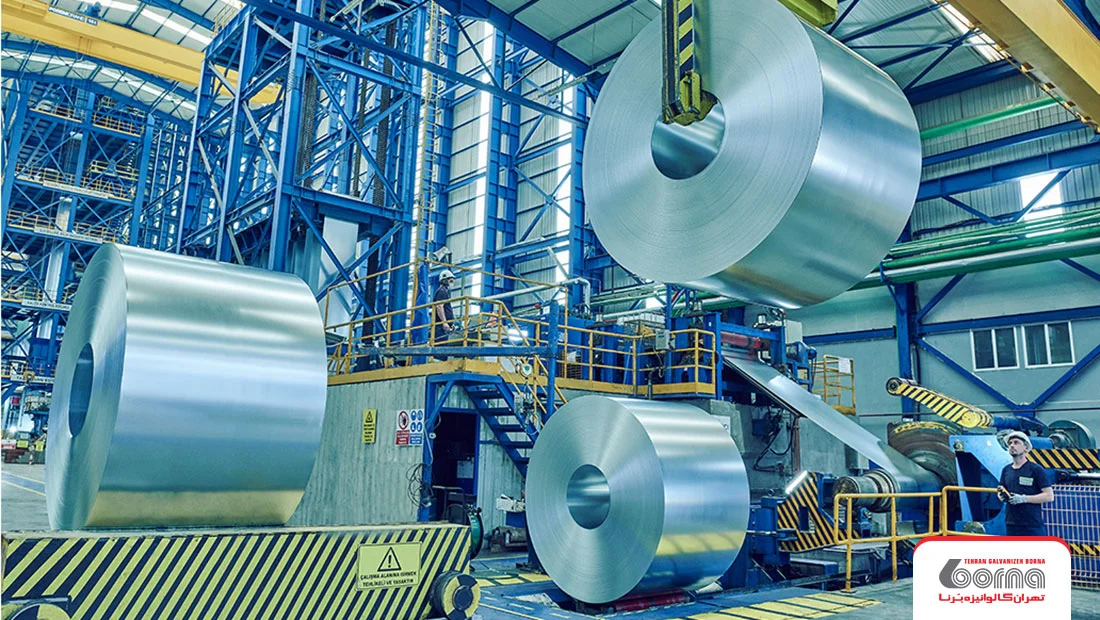
- Continuous Hot-Dip Galvanizing: Steel strip passes continuously through a galvanizing line, where a controlled zinc coating is applied before the strip is recoiled. This method is widely used to manufacture galvanized steel coils and sheets for subsequent forming and fabrication.
Electrogalvanizing (Electrolytic Zinc Coating)
In electrogalvanizing, zinc is deposited onto the steel surface through an electrochemical process using an electric current and an electrolyte containing zinc ions. This method allows precise control of coating mass and generally produces a uniform surface finish. It is used in certain automotive components, industrial products, and steel sheet applications requiring controlled surface characteristics.
Electrogalvanized coatings are often specified with lower coating masses than conventional hot-dip galvanized coatings, although coating thickness is not fixed for either process. Similarly, the lower processing temperature of electrogalvanizing does not, by itself, determine coating durability. A meaningful comparison must consider the zinc coating mass, service environment, surface treatments, and any additional protective coatings.
What Is Cold Galvanizing?
In some markets, the term cold galvanizing may refer either to electrogalvanizing or to the application of zinc-rich paints and sprays. Because these are different coating processes, using the term without further clarification can lead to misunderstandings when specifying or purchasing steel products.
Zinc-rich paint consists of zinc particles dispersed in a binder and is typically applied by brushing or spraying. Unlike electrogalvanized coatings or the metallurgically bonded zinc coating formed during hot-dip galvanizing, zinc-rich paints form organic or inorganic coating films, depending on the binder formulation.
The protective performance of zinc-rich coatings depends on factors such as surface preparation, zinc content, binder formulation, dry film thickness, and application quality. When properly formulated and applied, certain zinc-rich coating systems can also provide sacrificial corrosion protection.
Related article: What Is the Difference Between Hot-Dip and Cold Galvanizing?
When sourcing galvanized steel or specifying a zinc coating system, buyers should request the exact coating process and relevant technical specifications. The term "cold galvanizing" alone is not sufficient to identify the coating type or determine its expected performance.
Comparison of Zinc Coating Methods
| Coating Method | How the Coating Is Applied | Typical Applications | Key Selection Considerations |
|---|---|---|---|
| Batch Hot-Dip Galvanizing | Immersion of fabricated steel components in molten zinc. | Railings, posts, structural components, and outdoor equipment. | Component design, coating thickness, and applicable inspection standards. |
| Continuous Hot-Dip Galvanizing | Continuous passage of steel strip through a molten zinc bath. | Galvanized steel coils, sheets, and materials for subsequent forming and fabrication. | Steel grade, zinc coating mass, and protection of cut edges after fabrication. |
| Electrogalvanizing | Electrochemical deposition of zinc onto the steel surface using an electric current. | Specialized steel sheets, industrial components, and selected automotive applications. | Coating mass on each surface and requirements for additional protective treatments. |
| Zinc-Rich Paint | Application of a zinc-pigmented coating containing zinc particles dispersed in a binder. | Selected protective paint systems and localized coating repairs. | Paint formulation, surface preparation, application conditions, and dry film thickness. |
No zinc coating method is inherently the least expensive, most durable, or most suitable for every application. Selection should take into account the required corrosion protection, service environment, product geometry, coating specifications, processing requirements, and overall cost.
Other methods of applying protective zinc coatings include thermal spraying (zinc metallizing) and mechanical plating. These processes have distinct characteristics and should be specified and evaluated according to their respective technical requirements.
How Are Galvanized Steel Sheets Manufactured?
In many continuous hot-dip galvanizing lines, steel strip is cold-rolled to the required thickness before entering the coating line. Some lines can also process hot-rolled strip. The main stages typically include:
- Uncoiling and Strip Preparation: Steel coils are loaded onto an uncoiler, and the strip is fed into the galvanizing line. The ends of successive coils may be joined to support continuous operation.
- Surface Cleaning: Rolling oils, particles, and other surface contaminants that could interfere with coating adhesion are removed from the steel strip.
- Heat Treatment: Where an annealing furnace is used, the strip undergoes controlled heat treatment to develop the specified mechanical properties and prepare the surface for zinc coating.
- Immersion in Molten Zinc: The steel strip passes through a bath of molten zinc, where a protective metallic coating forms on both surfaces.
- Coating Mass Control: Equipment known as air knives uses controlled jets of air or gas to remove excess molten zinc and regulate the coating mass on the steel strip.
- Cooling and Finishing: Depending on the product specifications, subsequent operations may include cooling, skin-pass rolling, tension leveling, surface treatment, protective oiling, quality inspection, and recoiling.
Line configurations and processing sequences vary between manufacturers. Finished galvanized steel coils can subsequently be processed into cut-to-length sheets, corrugated roofing sheets, or roll-formed components, depending on the intended application.
How Are Steel Components Prepared for Batch Hot-Dip Galvanizing?
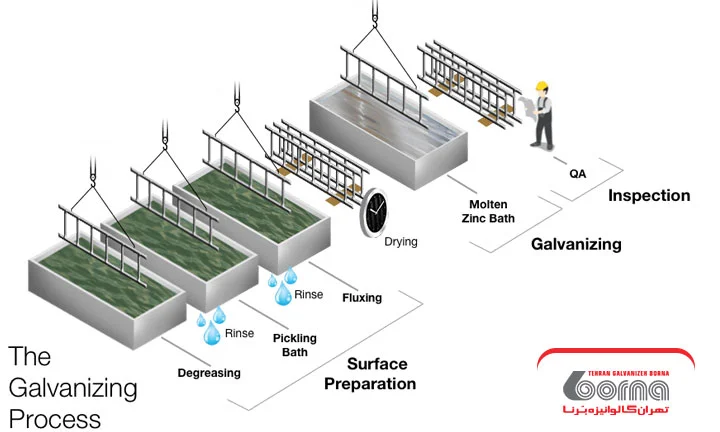
In batch hot-dip galvanizing, proper surface preparation is essential for achieving a continuous, well-adhered zinc coating. Contaminated surfaces may prevent the required reaction between molten zinc and steel, potentially resulting in uncoated areas or other coating defects.
The preparation process begins with degreasing and cleaning to remove oils, grease, and surface contaminants, followed by rinsing. The steel then undergoes acid pickling to remove rust and mill scale. Certain contaminants, such as welding slag and some resistant paints or coatings, may not be removed effectively by chemical cleaning alone and may require mechanical cleaning, such as wire brushing or grinding.
The final surface preparation stage typically involves fluxing. The flux helps remove residual oxides and limits reoxidation before immersion in molten zinc, promoting the formation of a metallurgically bonded zinc coating.
Component design also plays an important role in successful galvanizing. Hollow sections and enclosed assemblies must incorporate suitable venting and drainage openings to allow air to escape and cleaning solutions and molten zinc to flow freely into and out of the component.
Trapped liquids can compromise coating quality and create serious safety hazards during immersion in molten zinc. The location and dimensions of vent and drain holes should therefore be determined in consultation with the fabricator and galvanizing contractor.
How Long Does the Galvanizing Process Take?
The time a steel component spends immersed in the molten zinc bath should not be confused with the total processing time for a galvanizing order. According to guidance published by the American Galvanizers Association (AGA), the immersion stage in batch hot-dip galvanizing typically takes less than ten minutes, depending on the thickness and characteristics of the steel component.
Additional time is required for surface preparation, material handling, cooling, finishing, and inspection. The total processing time therefore depends on the component design, dimensions, production conditions, and galvanizing facility.
In continuous hot-dip galvanizing, the time required for the steel strip to pass through individual processing stages depends on the line speed, equipment configuration, and operating parameters. Consequently, a single fixed processing time, such as four or five minutes, cannot accurately represent the production of all galvanized steel products.
What Is the Difference Between Spangled and Spangle-Free Galvanized Steel?
The visible crystalline patterns found on some galvanized steel surfaces are known as spangle. Their appearance and size depend on factors such as zinc bath composition, solidification conditions, and manufacturing processes.
Galvanized steel sheets may have a pronounced spangle pattern, a minimized spangle appearance, or a relatively uniform surface with no readily visible spangle. The choice between these finishes is primarily influenced by appearance requirements and subsequent processing operations, such as painting or other surface finishing applications.
Larger spangles or a brighter surface finish do not necessarily indicate a heavier zinc coating or superior product quality. Galvanized steel should be evaluated according to its technical specifications, zinc coating mass, surface condition, and applicable product standards, rather than appearance alone.
What Is the Difference Between Steel Thickness and Zinc Coating Mass?
Base steel thickness and zinc coating mass are two distinct product specifications. The thickness of the steel substrate influences the sheet's weight and mechanical performance, while the zinc coating mass indicates the amount of protective zinc available to resist corrosion.
For continuously hot-dip galvanized steel sheets, zinc coating mass is commonly expressed in grams per square meter (g/m²). Under the coating designation system used in EN 10346, Z275 identifies a total coating mass class of 275 g/m² for both surfaces combined. The applicable edition specifies the sampling and acceptance requirements, including the three-spot test.
This value does not represent the thickness of the steel substrate or the coating mass on each individual surface. Applicable editions also establish requirements for individual specimens, commonly evaluated through the single-spot test.
Nominal coated-sheet thickness should also be distinguished from steel core thickness. Under EN 10346, the nominal thickness ordered for a metallic-coated product includes the steel substrate and the metallic coating on both surfaces. The steel core thickness excludes the coating and may be relevant to structural design calculations. Buyers should confirm the thickness convention specified in the applicable standard and purchase order.
| Specification | Description | Example |
|---|---|---|
| Base Steel Thickness | Thickness of the steel substrate alone, excluding the metallic coating; not necessarily the ordered nominal coated-sheet thickness. | 0.50 mm (illustrative steel core thickness) |
| Zinc Coating Designation | Standardized designation indicating the required zinc coating mass. | Z275 |
| Total Zinc Coating Mass | Combined zinc coating mass on both surfaces per unit area of the steel sheet. | Z275 denotes a 275 g/m² coating mass class (both sides combined); acceptance is governed by the applicable standard. |
| Approximate Coating Thickness per Side | Estimated zinc coating thickness, assuming approximately equal coating distribution on both surfaces. | Approximately 20 µm per side for Z275 (indicative value). |
The zinc coating thickness of steel components galvanized after fabrication is not necessarily the same as that of continuously galvanized steel sheets. The required coating thickness for fabricated components depends on factors such as product type, base steel thickness, steel composition, and applicable galvanizing standards.
Therefore, a coating thickness range such as 70–100 µm should not be treated as a universal specification for all galvanized steel products. Coating requirements must be determined according to the galvanizing process, intended application, and relevant product standard.
What Factors Affect Galvanizing Quality?
The quality of a galvanized coating depends on the interaction between steel composition, surface preparation, and process control. In batch hot-dip galvanizing, the chemical composition of the steel, particularly its silicon and phosphorus content, can significantly influence the coating's growth rate, thickness, and appearance. As a result, two steel components galvanized in the same zinc bath may develop coatings with different surface appearances.
A thicker zinc coating does not necessarily indicate better overall quality. In certain steel grades, increased reactivity with molten zinc can lead to excessive growth of zinc-iron intermetallic layers. This may produce a relatively brittle coating that is more susceptible to mechanical damage or flaking under certain conditions. Selecting steel with suitable chemical characteristics and consulting the galvanizing contractor before fabrication can help minimize these risks.
Achieving a uniform, high-quality coating requires thorough surface cleaning, appropriate control of zinc bath conditions, and effective drainage of excess molten zinc. In continuous steel strip galvanizing, accurate coating mass control, surface quality management, and proper finishing operations are equally important. The finished product should undergo the relevant inspections and tests to verify compliance with the specified quality requirements.
How Is Galvanized Coating Quality Inspected?
A galvanized coating inspection typically covers several key areas:
- Visual Inspection: Checking for uncoated areas, flaking, handling damage, and surface defects that could affect the product's intended use. Differences in color or surface appearance alone do not necessarily constitute grounds for rejection.
- Coating Thickness or Mass Measurement: For fabricated hot-dip galvanized components, magnetic coating thickness gauges are commonly used for non-destructive measurement. For galvanized steel sheets and coils, measurement and sampling procedures should comply with the applicable product standard and be consistent with the manufacturer's inspection documentation.
- Coating Adhesion and Formability: Appropriate tests may be used to evaluate coating adhesion and its ability to withstand forming or fabrication. The test method should be selected according to the product type, applicable standard, and intended application.
- Documentation and Traceability: The steel grade, dimensions, coating designation, and coil or batch identification should be checked against the purchase order, mill test certificates, where provided, and the delivered material.
Results from salt spray testing of galvanized steel must also be interpreted correctly. The number of hours a coating withstands a salt spray test cannot be converted into years of actual service life using a fixed conversion factor. Although this accelerated test can be useful in certain quality control programs, it does not replace an assessment of the actual service environment and exposure conditions.
Applications of Galvanized Steel
The versatility of galvanized steel comes from combining the mechanical properties of steel with the corrosion protection provided by zinc. The appropriate product should be selected according to its steel grade, thickness, coating type, and intended service conditions.
- Construction and Industrial Buildings: Roofing and wall cladding, gutters, flashing, and selected light-gauge steel sections.
- HVAC and Building Services: Ventilation ductwork, cable trays, and equipment enclosures.
- Automotive Manufacturing: Selected vehicle body panels and components, often used in combination with additional protective coating systems.
- Infrastructure and Public Facilities: Railings, safety barriers, lighting poles, and hot-dip galvanized structural components.
- Industrial and Agricultural Equipment: Equipment housings, shelving systems, wire mesh, and selected greenhouse components.
For example, the coating requirements for indoor ventilation ductwork differ from those of roofing installed in a coastal environment. In coastal applications, factors such as salt exposure, the duration of surface wetness, and installation details play a greater role in selecting the appropriate corrosion protection system. The suitability of galvanized steel for an application does not mean that every galvanized steel grade or coating specification will perform equally well under those conditions.
Advantages of Galvanizing
- Improved Corrosion Protection: The zinc coating helps delay the onset of corrosion in the underlying steel and can extend the service life of steel products when appropriately specified for the operating environment.
- Reduced Maintenance Costs: When correctly specified, galvanizing can extend the intervals between maintenance, repair, and component replacement. This is particularly valuable for infrastructure and equipment that are difficult to access or costly to take out of service. A meaningful economic comparison should consider the total life-cycle cost, including initial purchase, installation, maintenance, and eventual replacement.
- Formability: Galvanized steel sheets with suitable mechanical properties can be used for bending, roll forming, and the production of formed components. Successful processing depends on the steel grade, coating type and mass, forming equipment, and bend radius.
- Suitability for Painting: With appropriate surface preparation and compatible coating materials, galvanized steel can be painted to achieve a specified appearance while providing additional corrosion protection.
- Recyclability: Galvanized steel is recyclable, and zinc can also be recovered through appropriate recycling processes. Extended product service life and fewer replacement cycles can provide additional benefits when the coating is correctly specified and used.
Limitations of Galvanizing
Galvanizing is not equally suitable for every operating environment. Highly acidic or alkaline conditions, exposure to certain chemicals, and aggressive salt-containing environments can accelerate zinc corrosion. Performance in water and soil also depends on factors such as chemical composition, temperature, and exposure conditions. The presence of moisture alone is not sufficient to predict coating service life.
High-temperature exposure is another important consideration. The temperature of the molten zinc bath during galvanizing should not be confused with the maximum recommended service temperature of the finished coating. Suitability for elevated-temperature applications should be assessed according to the product type, operating temperature, duration of exposure, and manufacturer's technical guidance.
Cutting, severe abrasion, improper bending, and welding can damage the protective zinc coating. In batch hot-dip galvanizing, the geometry and thickness of individual components must also be suitable for the process. Poorly balanced designs or inappropriate fabrication practices can increase the risk of distortion during galvanizing.
By reducing corrosion, a galvanized coating helps preserve the steel's thickness and structural integrity over time. However, the load-bearing capacity of a steel structure depends on the steel grade, component dimensions, and structural design. Applying a zinc coating does not, by itself, increase the structural load capacity of the underlying steel.
Painting Galvanized Steel and Duplex Coating Systems
Painting galvanized steel can provide additional corrosion protection while achieving the required color and appearance. For steel components hot-dip galvanized after fabrication, the combination of galvanizing with a compatible paint or powder coating system is commonly referred to as a duplex system.
To achieve reliable paint adhesion, the galvanized surface must be properly prepared to remove oils, contaminants, and substances that may interfere with coating adhesion. Surface preparation methods and paint selection should be compatible with the condition of the zinc coating and any previously applied surface treatments. A bright, visually clean galvanized surface does not necessarily guarantee satisfactory paint adhesion without appropriate preparation.
For factory-produced prepainted steel coils and sheets, performance depends on the metallic-coated steel substrate, surface pretreatment, primer, and topcoat. Not all prepainted steel products use conventional zinc-coated steel as their substrate; some are manufactured using other metallic-coated steel products with different coating compositions and performance characteristics.
Cutting, Welding, and Repairing Galvanized Coatings
Galvanized steel can be cut, formed, and welded using appropriate fabrication techniques. However, the selected process must be compatible with the type of galvanized sheet or fabricated component. During welding, the zinc coating can influence welding parameters and may be damaged or removed in the weld area, reducing local corrosion protection.
Welding galvanized steel can generate zinc oxide fumes. Appropriate welding procedures and effective local exhaust ventilation are essential for controlling exposure to welding fumes.
After fabrication or installation, areas where the galvanized coating has been damaged should be inspected and repaired where necessary. ASTM A780/A780M, which covers the repair of damaged or uncoated areas on hot-dip galvanized steel products galvanized after fabrication, describes repair methods including zinc-rich paints, zinc-based solders, and zinc thermal spraying (metallizing).
The selected repair method, surface preparation, and required repair coating thickness should comply with the applicable standard and the product specifications.
Repair materials should be selected based on their documented technical properties and suitability for corrosion protection. A silver or metallic appearance alone does not indicate that a paint or spray can provide effective protection for steel.
For continuously galvanized steel coils and sheets and prepainted steel products, the treatment or repair of cut edges and damaged areas should follow the manufacturer's recommendations and the relevant product specifications.
Localized coating repair aims to restore corrosion protection to the affected area. However, the repaired coating may differ from the original galvanized coating in its composition, structure, and bonding mechanism.
What Should Be Considered When Galvanized Steel Comes into Contact with Other Metals?
When two dissimilar metals are in electrical contact in the presence of an electrolyte, such as water containing dissolved salts, galvanic corrosion may occur. This electrochemical process can cause one of the metals to corrode faster than it would under the same conditions on its own.
When connecting galvanized steel to metals such as copper, brass, or stainless steel, factors including the materials in contact, moisture exposure, and the relative surface areas of the metals should be considered. Where necessary, suitable insulating materials, electrical isolation, and measures to prevent water accumulation can help reduce the risk of galvanic corrosion.
Contact between dissimilar metals does not automatically result in unacceptable corrosion. The actual risk depends on the metal combination, area ratio, joint design, and environmental exposure.
How Long Does Galvanized Steel Last?
There is no single service life that applies to all galvanized steel products. The service life of a galvanized coating depends on several factors, including:
- Zinc coating mass and thickness
- Environmental corrosivity and the duration of surface wetness
- Exposure to salts and industrial pollutants
- Component design, installation quality, and drainage conditions
- The condition of cut edges, connections, and damaged coating areas
- The presence and quality of additional protective coatings, such as paint
Under suitable service conditions, certain galvanized coatings can provide corrosion protection for several decades. However, expected service life should be assessed according to the coating specification and actual environmental exposure.
What Is White Rust on Galvanized Steel?
White rust is a term commonly used in the steel market to describe white or gray zinc corrosion deposits that may develop on galvanized surfaces. When these deposits form because moisture becomes trapped between closely stacked sheets or adjacent layers of a steel coil, the condition is more precisely described as wet storage stain.
This type of surface corrosion typically develops when moisture remains trapped between galvanized surfaces and air circulation is restricted. Inadequate ventilation and prolonged exposure to damp storage conditions can accelerate its formation.
Wet storage stain is distinct from red rust on steel. The appearance of white deposits does not necessarily mean that the protective zinc coating has been completely consumed. However, the condition should not be ignored.
The extent of corrosion, the amount of remaining zinc coating, and the surface quality requirements of the intended application should be considered. Simply removing visible deposits does not necessarily restore the coating to its original condition or performance.
Storage and Handling of Galvanized Steel
Although galvanized steel is designed to provide corrosion protection in a range of environments, improper storage can still cause surface deterioration. Moisture trapped between closely packed sheets or coil wraps creates conditions that differ from those experienced by freely exposed galvanized surfaces.
To minimize the risk of wet storage stain and handling damage, the following precautions are recommended:
- Store galvanized steel coils and sheets in a dry, well-ventilated area, elevated off the ground.
- Protect packages from rain, standing water, and moisture ingress during transportation and handling.
- Do not leave wet packaging or protective coverings in place if they trap moisture against the steel surface.
- If the material becomes wet, arrange for safe separation, ventilation, and drying in accordance with the manufacturer's recommendations.
- Inspect stored packages regularly and avoid unnecessarily prolonged storage periods.
Protective oiling and chemical surface treatments, including suitable passivation treatments, may help reduce the risk of wet storage stain. However, these treatments do not replace proper packaging, transportation, and storage practices.
Galvanized Steel vs. Hot-Rolled Steel, Cold-Rolled Steel, Aluzinc, and Stainless Steel
These steel products differ in their manufacturing processes, coating systems, alloy compositions, and corrosion protection characteristics. Some terms describe the rolling process, whereas others specify a metallic coating or the steel alloy itself.
| Steel Product | Key Characteristics | Corrosion Protection |
|---|---|---|
| Hot-Rolled Steel | Steel produced by hot rolling, often with a dark, mill-scaled surface unless subsequently pickled or otherwise finished. | Conventional uncoated carbon steel requires suitable corrosion protection when exposed to corrosive environments. |
| Cold-Rolled Steel | Steel processed by cold rolling, generally offering tighter dimensional tolerances and a smoother surface finish. | Protective oiling can provide temporary corrosion protection during handling and storage. |
| Galvanized Steel | Steel with a protective metallic zinc coating. | Corrosion protection depends on zinc coating mass, environmental exposure, and surface condition. |
| Aluminum-Zinc Alloy-Coated Steel (Aluzinc) | Steel with a metallic coating based on an aluminum-zinc alloy. | Corrosion protection characteristics and application limitations differ from those of conventional zinc-coated steel. |
| Prepainted Galvanized Steel (PPGI) | Galvanized steel with an additional organic paint coating system. | Performance depends on the underlying metallic coating, surface pretreatment, and paint system. |
| Stainless Steel | A steel alloy containing sufficient chromium to form a protective passive surface film. | Corrosion resistance is provided by the alloy composition and the formation of a protective passive surface film. |
Stainless steel and galvanized steel are not interchangeable materials. In galvanized steel, a zinc coating protects the underlying steel. In stainless steel, chromium in the alloy enables the formation of a thin, protective passive film on the surface. The appropriate material should be selected according to the service environment, technical requirements, and overall cost.
Similarly, Aluzinc is not another name for conventional zinc-coated steel. When comparing metallic-coated steel products, buyers should consider the coating alloy composition, coating mass, corrosion protection requirements, and intended application.
Key Standards for Galvanized Steel
The applicable galvanizing standard depends on the product type and manufacturing process. Standards for continuously galvanized steel coils and sheets differ from those covering steel components galvanized after fabrication.
| Standard | Main Scope |
|---|---|
| ASTM A653/A653M | Hot-dip zinc-coated (galvanized) and zinc-iron alloy-coated (galvannealed) steel sheet supplied in coils and cut lengths. |
| EN 10346 | Technical delivery requirements for continuously hot-dip coated flat steel products for cold forming, covering several types of metallic coatings. |
| ISO 1461 | Specifications and test methods for hot-dip galvanized coatings on fabricated iron and steel articles within the standard's defined scope. |
| ASTM A123/A123M | Requirements for hot-dip galvanized coatings on specified iron and steel products and fabricated components. |
| ASTM A879/A879M | Electrolytically zinc-coated steel sheet, including the designation of zinc coating mass on each surface. |
| ASTM A780/A780M | Repair methods for damaged or uncoated areas of hot-dip galvanized coatings on applicable fabricated steel products. |
A purchase specification should identify the steel grade, coating designation, dimensions, dimensional tolerances, and agreed edition of the applicable standard. A statement such as "manufactured to standard" is insufficient without identifying the standard and product requirements.
Products such as fasteners, steel wire, and certain types of pipe may be covered by separate product-specific standards. Requirements intended for general fabricated components should not be applied to these products without confirming the relevant standard and its scope.
What Should Buyers Consider When Purchasing Galvanized Steel?
When sourcing galvanized steel coils and sheets, buyers should first define the intended application and expected service conditions. Supplier quotations should then be compared against equivalent technical specifications and order requirements.
- Steel Grade: Steel intended for general bending, deep drawing, or structural applications may require different mechanical properties and material grades.
- Thickness and Tolerances: Specify the required nominal thickness, the basis of thickness measurement, and the acceptable dimensional tolerances.
- Zinc Coating Mass: Select the appropriate coating designation according to the service environment and corrosion protection requirements. The description "galvanized" alone does not define the required coating.
- Surface Quality: Inspect for uncoated areas, coating flaking, deep scratches, wet storage stain, and handling or transportation damage that may affect the intended application.
- Further Processing: If the steel will undergo painting, welding, bending, or roll forming, confirm that the surface treatment, oiling condition, and coating specification are compatible with the planned operations.
- Product Documentation: Verify the manufacturer, coil or batch identification, and any required mill test certificates against the delivered material.
- Dimensions and Delivery Form: Confirm the required width, length, coil weight, sheet dimensions, and any additional slitting, cutting, or forming requirements before ordering.
When comparing galvanized steel prices, buyers should ensure that the offers cover equivalent steel grades, thicknesses, dimensions, zinc coating masses, surface quality requirements, order quantities, and processing services.
A lower price offers commercial value only if the material also meets the required technical specifications and is fit for its intended use.
Choosing the Right Galvanized Steel for Your Application
Galvanizing is an established method of improving the corrosion resistance and service life of iron and steel through the application of a protective zinc coating. Its effectiveness depends on selecting the appropriate combination of steel grade, zinc coating specification, manufacturing process, and service conditions.
For buyers seeking galvanized steel coils and sheets, Tehran Galvanizeh Borna, specializes in sourcing products from Iranian and international steel manufacturers.
Ahan Shop helps industrial buyers identify products that meet their technical specifications, order quantities, and commercial requirements across a range of steel grades, dimensions, and coating options. Galvanized steel can be sourced in coil and cut-to-length sheet formats, subject to product availability and order specifications.
FAQs
Answers to common questions that may arise for you while reading this article.
گالوانیزه کردن یعنی پوشاندن سطح آهن یا فولاد با لایهای از فلز روی برای کاهش خوردگی و زنگزدگی.
روی علاوه بر ایجاد یک لایه محافظ، در شرایط مناسب زودتر از آهن خورده میشود و از فولاد زیرین محافظت میکند.
در گالوانیزه گرم، فولاد در حمام روی مذاب پوشش داده می شود. اصطلاح «گالوانیزه سرد» در بازار گاهی برای آبکاری الکتریکی و گاهی برای رنگ غنی از روی به کار می رود.
بله. اگر پوشش روی به مرور مصرف شود یا آسیب جدی ببیند، فولاد زیر آن می تواند زنگ بزند.
طول عمر آن به مقدار پوشش روی، شرایط محیط، کیفیت نصب و نگهداری بستگی دارد.
گالوانیزه با پوشش روی محافظت می شود ولی در استیل ضدزنگ، کروم موجود در آلیاژ باعث تشکیل لایه ای محافظ روی سطح می شود.
بله. سطح باید به درستی تمیز و آماده شود و رنگ با پوشش روی سازگار باشد.
بله. بسته به نوع محصول و میزان آسیب، میتوان از روشهایی مانند رنگ غنی از روی یا پاشش حرارتی روی استفاده کرد.
How would you rate this article?
Help us provide better content by registering your rating.
Related Articles
-
Shipping Container Steel: Types, Thicknesses and Selection Guide
Which steel is best for shipping containers? Compare Corten, galvanized, and prepainted steel, with a thickness guide for container walls and roofs.
40 minutes of study time -
Steel Sheets and Plates for Industrial Sheds
Compare hot-rolled, galvanized and prepainted steel for industrial sheds. Explore sheet thicknesses, roofing and cladding applications, and selection guidelines.
40 minutes of study time -
Choosing the Right Steel Sheets and Plates for Tank Fabrication
Compare carbon steel, galvanized steel and stainless steel for tank fabrication. Explore plate thicknesses, corrosion protection and tank design standards.
20 minutes of study time
Add a comment
What Is Galvanizing? Methods and Applications